

Choosing where to submit a research paper feels like a prestige question. It is really a search question. A journal and conference ranking database search tool, queried by discipline first and tier second, turns a vague sense of the field into a shortlist you can defend in front of your advisor. To show what that search actually surfaces, we ran it against our own venue database and counted what is in there.
What the database holds, by discipline
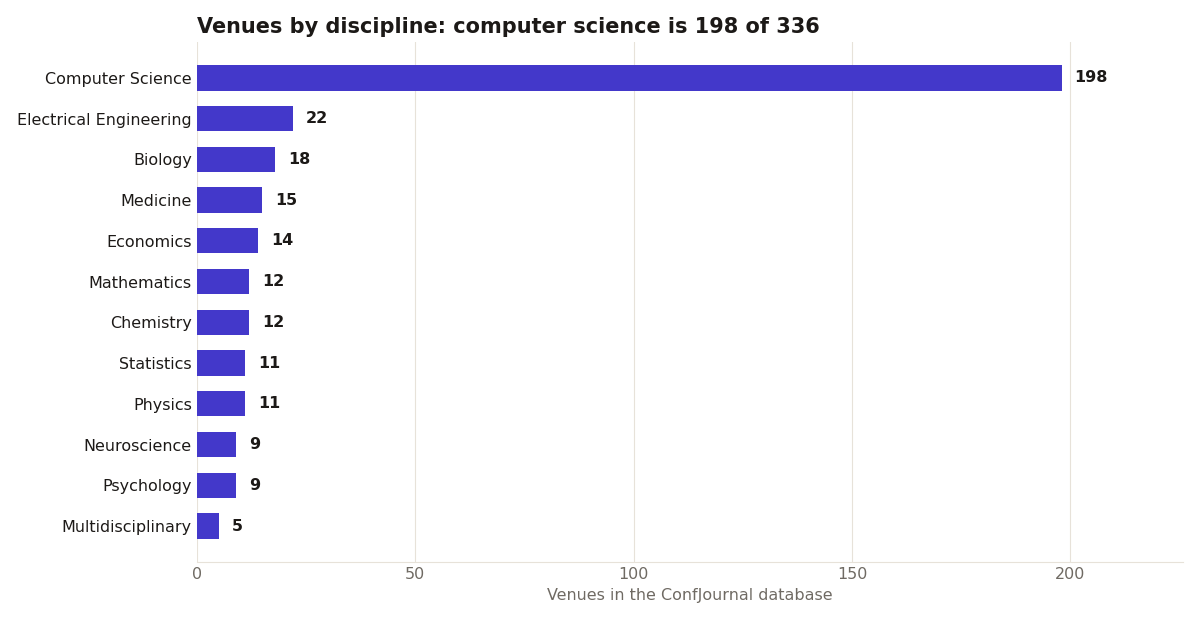
The database combines 336 unique venues: 192 journals and 144 conferences. Computer science dominates with 198 venues, just under three in five. Electrical engineering follows at 22, then biology at 18, medicine at 15, economics at 14, mathematics and chemistry at 12 each, statistics and physics at 11 each, neuroscience and psychology at 9 each, and 5 multidisciplinary venues. Inside computer science, the deepest benches are software engineering (14 venues), theory (11), and programming languages (9).
The split between journals and conferences is just as uneven. Computer science holds 134 of the 144 conferences, and electrical engineering holds the other 10. Every other discipline in the database is journals only. That reflects how those fields actually publish, and it changes the search: a computer scientist filters a crowd of deadline-driven venues, while a biologist picks from a corridor of rolling journals. Either way, discipline comes first, because reviewers decide your paper's fate, and reviewers live inside disciplines.
The tier data sharpens the picture further. Among journals, computer science is where the spread lives: 48 of its 64 journals are Q1 and the other 16 are Q2, and those 16 are the only Q2 journals in the entire database. Every journal outside computer science and electrical engineering is Q1 here. Among conferences, 126 of the 144 carry a CORE grade of A or A*. So a search that filters by discipline and then by tier behaves differently per field: in medicine it mostly confirms the obvious, while in computer science it does real sorting work.
One more practical consequence: because the conference side of the database is almost entirely computer science and electrical engineering, authors in other fields should weight the journal fields, quartiles, and rolling submission windows, and treat conference advice, including most of this site's deadline coverage, as CS-centric. Knowing what a database is made of is part of using it well.
The shortlist the field already agrees on
Within computer science, the venues researchers name first, by area:
- Machine learning: NeurIPS, ICML, ICLR.
- Computer vision: CVPR, ICCV, ECCV.
- NLP: ACL, EMNLP, NAACL.
- Data mining: KDD, ICDM, SDM.
- Systems: OSDI, SOSP, NSDI, EuroSys.
- Databases: SIGMOD, VLDB, ICDE.
- Security: IEEE S&P, CCS, USENIX Security.
- Theory: STOC, FOCS, SODA.
- HCI: CHI, UIST.
Treat that list as the starting filter, not the answer. The database search earns its keep on the next layer down: the strong specialist venues one tier below the famous names, where a well-matched paper gets a fairer reading.
The walkthrough: from a search result to three names
Once the discipline filter gives you a candidate set, narrow it with the walkthrough that has always worked: identify your paper's closest three published relatives, note where they appeared, and submit there. Venues are communities; your paper will be reviewed by the people who wrote those relatives.
Use the ranking database to sanity check the result. Confirm each candidate's tier, its deadline month, and whether it is a journal with rolling submissions or a conference with one annual shot. When torn between two venues, submit to the one whose reviewers will champion the work, not merely tolerate it.
Interdisciplinary papers: pick the venue whose reviewers will understand the harder half of your contribution. A vision paper with a theory core belongs wherever the theory reviewers sit. When torn, ask your advisor which community they want you hired by.
Run the search yourself
Every venue counted above is searchable on this site. The ConfJournal search page filters the same database by discipline, tier, and deadline. When your shortlist is down to a handful, build it in Odds Check, our free tool that adds up the acceptance chances across a list of up to eight venues, using recorded rates where the database has them and your own estimates, clearly badged, where it does not.
Star the three venues you will actually target this year; a shortlist beats a database. Sources: IEEE, ACM