

Every submission checklist starts with the template. Ours starts one step earlier, with the venue itself. The most expensive mistake in academic publishing is a flawless, perfectly formatted paper sent to the wrong tier of venue: too ambitious, and it burns a review cycle; too modest, and it undersells a year of work. So before the free paper submission checklist app options, here is the tier landscape they should be checked against, counted from our venue database.
Step zero: verify the tier before the template
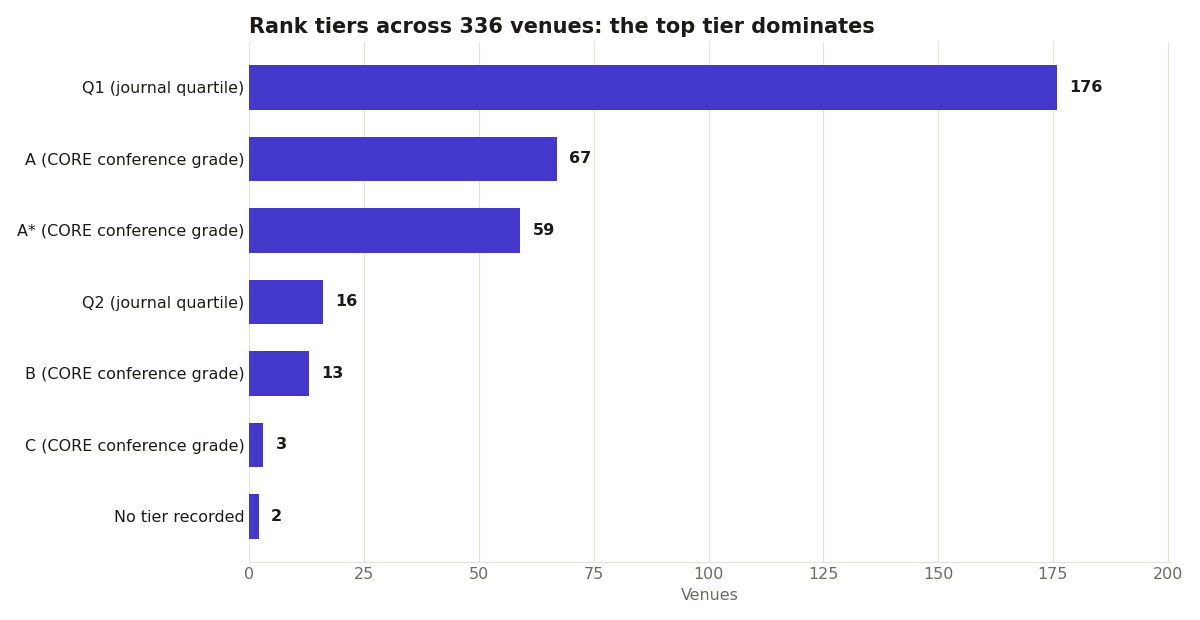
The database mixes two ranking systems, and a good checklist keeps them separate. Journals carry quartiles: 176 of the 192 journals are Q1 and 16 are Q2, so 92 percent of the journals here sit in the top quartile. Interestingly, every one of the 16 Q2 journals is a computer science journal; outside CS, this collection is Q1 only. Conferences carry CORE grades: of the 144 conferences, 59 are A*, 67 are A, 13 are B, 3 are C, and 2 record no grade.
Add the top of both systems together and 235 of the 336 venues, about 70 percent, are top tier. That is a property of a curated database, not of academia at large, and it carries a practical lesson: in a list like this, a top-tier label is a floor check, not a finish line. The checklist question is not whether the venue is ranked. It is whether this paper, at this strength, belongs in the A* line, the A line, or a journal queue, and that judgment comes before any formatting.
Run the same count inside the conference system and the pattern repeats: A* and A together account for 126 of the 144 conferences, about 88 percent. A database curated around venues worth submitting to will always skew top-heavy, which is precisely why the tier check belongs on the checklist as a comparison, not a compliment. Your paper is not competing with the tier label; it is competing with the other papers in that tier's queue this cycle.
A worked example makes it concrete. Say the checklist is for a solid systems paper with good but not startling results. Item zero reads: venue, tier A conference, deadline month copied from the database. The honest tier question is whether the paper's evaluation is strong enough for the A* line or whether the A line, with friendlier reviewers and a faster cycle, gets it published a year sooner. That decision, made calmly in item zero, is worth more than every formatting item below it combined.
The checklist itself
The submission checklist, digitized:
- Official template, unmodified.
- Page limit respected (9 pages NeurIPS, 8 pages CVPR main track).
- Anonymized: no names, no self-citing giveaways.
- Abstract registered by the separate deadline.
- Author list frozen (NeurIPS locks it at abstract time).
- Supplementary within size limits (50MB PDF at NeurIPS).
- Checklist and ethics statements completed.
Add item zero at the top of that list: venue name, tier, and deadline, copied from the ranking database entry, not from memory. Tiers change, deadlines drift by a week between cycles, and last year's call for papers is the most dangerous document in your downloads folder.
Free options that hold up
Free options: a shared checklist in Notion or Google Docs beats most dedicated apps, because your whole author list can tick boxes. OpenReview shows venue-specific requirements inline. VenueFit generates a per-venue checklist automatically, free.
Whatever tool you pick, print the checklist for deadline week; paper on the desk beats a tab buried among forty others. And run the tier check in Odds Check while you are at it: it builds target lists from this same database and badges which acceptance rates are recorded and which are your own estimates, so the ambition of the list is visible before the checklist even starts.
The checklist exists because desk rejections are the dumbest way to lose a paper. Template violations and missed abstract registrations kill submissions before review. A tier mistake is quieter and costs more: the paper was fine, the formatting was fine, and the venue was simply wrong. Sources: IEEE, ACM