

Every deadline app promises the same thing: no more ambushes. Whether it delivers depends on the calendar underneath it. Conference submission deadlines are not spread evenly across the year, and an app that treats them as if they were will lull you through the quiet months and drown you in the busy ones. Here is the actual shape of the calendar, counted from our venue database, and then the download list that copes with it.
The calendar behind the apps: deadlines cluster hard
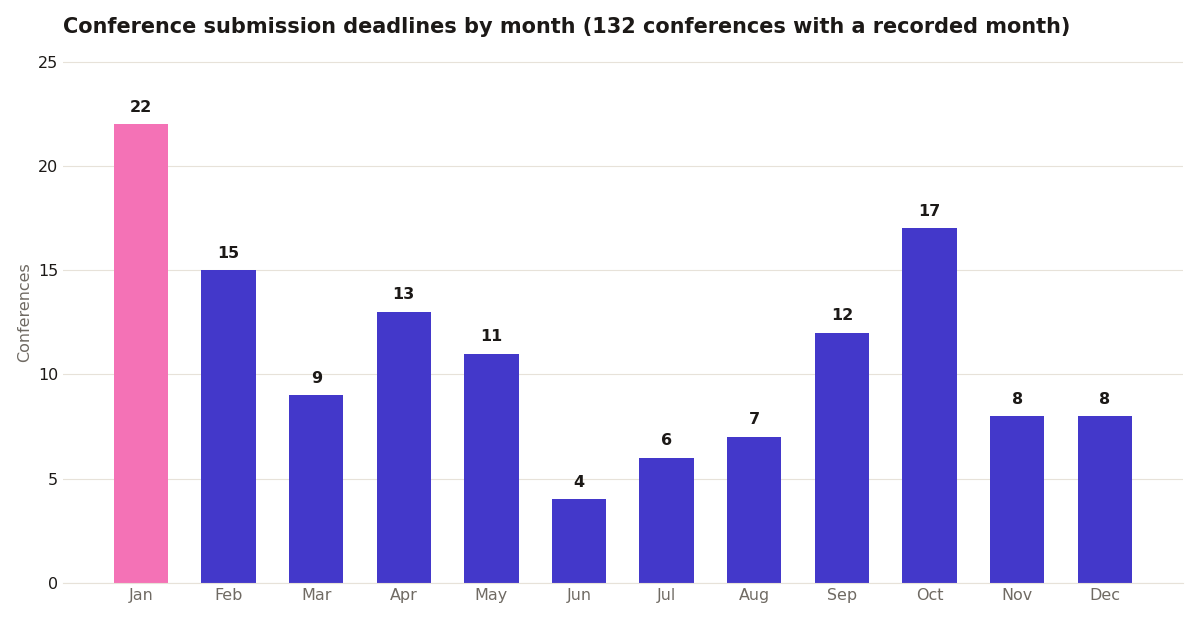
Of the 144 conferences in the database, 132 record a specific deadline month. January is the peak with 22 deadlines, roughly one in six. October follows at 17 and February at 15, so the top three months hold 54 of the 132 deadlines, about 41 percent. The summer is the trough: June, July, and August together hold only 17. The remaining 12 conferences record no deadline month at all, and all 192 journals in the database take rolling submissions instead.
Two honesty notes. First, these are tentative deadline months, the month a venue usually runs its call, not a promise for a specific year; always confirm against the live call for papers. In our data, 23 of the conference months carry high confidence, 108 medium, and 13 low. Second, a rolling journal is not a deadline-free journal in practice: your own target date is the deadline, and the apps below are how you keep it real.
The cluster is mostly a computer science story. Of January's 22 deadlines, 20 belong to CS conferences, and CS accounts for 122 of the 132 month-dated conferences overall; the 10 electrical engineering conferences all record a month too. If your field is CS, your year has a shape: build in the autumn, submit into the January and February wall, recover in the summer trough, and keep one eye on October. A deadline app that knows your subfield can warn you in November. A generic one warns you in January, which is the ambush itself.
Set three alerts per target venue: one when the call for papers opens, one thirty days out, and one at abstract registration. The middle alert is the one people skip, and it is the one that saves the paper, because thirty days is enough time to fix an experiments section and not enough time to panic about it.
The download list, by job
- Discovery: WikiCFP, Conference Alerts.
- ML tracking: OpenReview.
- Submission portals: EasyChair, CMT, HotCRP (web, bookmark them).
- Writing: Overleaf.
- Coordination: Slack or your lab's chat, with deadline channels.
Download all five categories, then delete anything you have not opened in a month. App sprawl is procrastination with icons. Given the January and October pile-ups, set your alerts to fire at the abstract registration deadline, not the paper deadline; at many venues the registration closes a week earlier and is not optional.
Save portal confirmation emails in a dedicated folder; lost confirmations cause deadline-week panic. Ask alumni which system they used; proven beats novel. Borrow the senior's spreadsheet before building your own.
The deadline week kit
The guide nobody writes: put the submission portal login in your password manager before deadline week, test-upload a dummy PDF early (portals break under load), and keep the venue's contact email handy. Deadline day failures are always logistical, never intellectual. The download that matters most is the PDF of the call for papers, saved locally, because it is the one document that settles every argument about page limits and dates.
Put the calendar in one place
Our own tool, Odds Check, is built on the same database behind the chart above. Build a target list of up to eight conferences and journals, check their deadline months side by side, and see the combined acceptance picture before you commit your January to three simultaneous submissions. Pair it with the month-by-month deadlines guide in the related reading below, and the calendar stops being weather and starts being a plan you can actually schedule experiments, writing, and rebuttals around. Sources: IEEE, ACM