

If you write machine learning conference papers, Europe is not a side circuit. It runs flagship venues of its own, and its calls for papers land on a different rhythm from the North American calendar. This guide counts the European circuit from our own venue database first, so the recommendations that follow rest on recorded locations rather than reputation, and then walks the 2026 calls worth watching.
Counting the European circuit, honestly
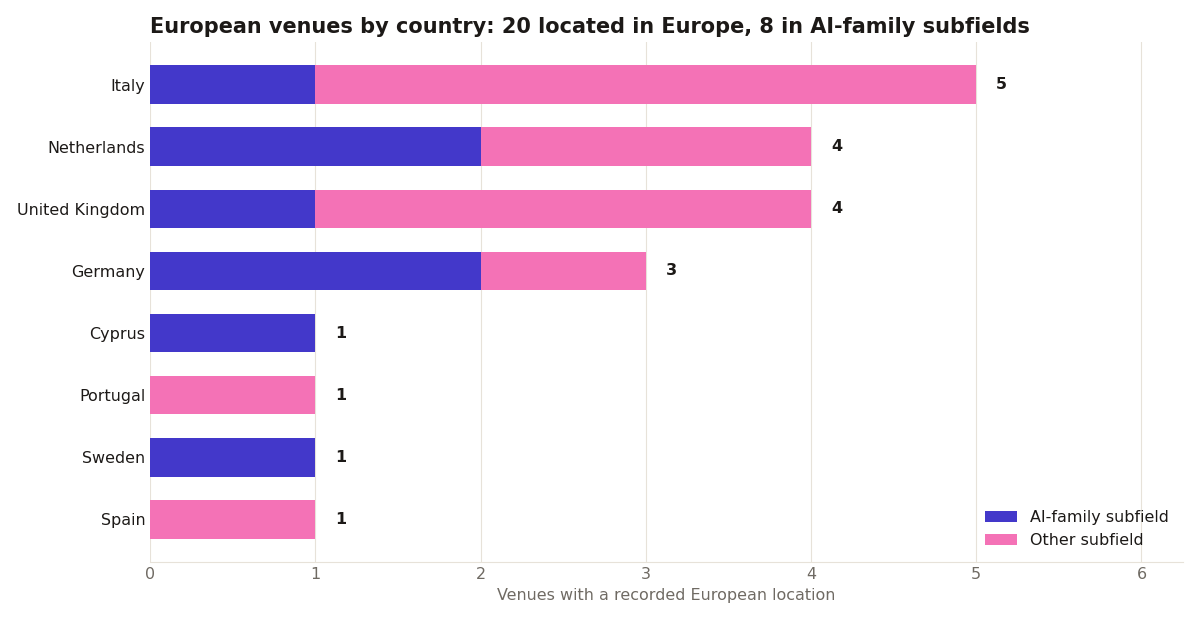
Start with a caveat the data forces on us: only 56 of the 336 venues in the database record a location at all, and every one of them is a conference. Journals record no location in our data, so they are invisible on this map. Of those 56 located conferences, 23 sit in the United States and 20 in Europe. Nobody should quote a European share of all venues from this; the honest statement is that among located conferences, Europe is nearly level with the US.
Italy leads the European count with 5 venues, helped by ECML PKDD in Naples. The Netherlands and the United Kingdom hold 4 each: Amsterdam hosts UAI, Maastricht hosts IJCNN, and Lancaster hosts BMVC. Germany holds 3, two of them heavyweights in Bremen, IJCAI and ECAI. Cyprus, Portugal, Sweden, and Spain hold 1 each, and Sweden's single entry is a flagship: ECCV in Malmo. Eight of the 20 European venues sit in AI-family subfields, which is why this circuit matters so much for machine learning papers specifically.
Read city by city, the map has texture. Rome hosts two security and cryptography fixtures, ESORICS and EUROCRYPT. Edinburgh holds HRI and EuroSys in the same year. The Hague hosts ACM CCS, Utrecht hosts CoNEXT, Karlsruhe hosts the Internet Measurement Conference, Lisbon hosts the constraint programming conference, Bari hosts ISMAR, and Barcelona hosts ICASSP. Europe's spread is not one mega-hub; it is a rail network of mid-sized university cities, each with a community that comes back every year.
There is a long tail here too. Design, Automation and Test in Europe, held in Verona, is a B-tier venue in our data and one of only eight venues in the whole database with a recorded acceptance rate, 24.8 percent. For an ML-adjacent hardware or automation paper, a venue like that can be a better strategic bet than a famous name with a single-digit rate, and it is exactly the kind of option a location-first search surfaces.
The 2026 calls worth watching
- ECCV 2026: Malmo, Sweden, September 8-13. Paper registration March 6, 2026. The European vision flagship.
- IJCAI 2026: Bremen, Germany, August 8-14. Broad AI.
- ICIP 2026: Tampere, Finland, September 13-17. Image processing.
- ECAI: Europe's AI conference, summer cycle.
Calls are published 6 to 9 months out; set calendar alerts for the registration deadlines, which are mandatory and earlier than the paper deadline at most vision venues. Book travel early for Malmo and Bremen; university towns fill fast during conference weeks.
Why Europe, and what it costs
Why Europe matters: travel costs from European labs are lower, visa logistics are simpler for many nationalities, and several European venues run excellent workshops. If you are US-based, budget the travel honestly: European conferences cost more in flights but often less in registration. And the coffee is better. That is not nothing during poster sessions.
The best home for a machine learning paper depends on whether your community reads proceedings or journals, and on which side of the Atlantic your likely reviewers sit. A paper aimed at the European vision community belongs at ECCV or BMVC even when a US venue looks shinier on paper.
Plan the circuit with the database
The venues above are drawn from the same database as the chart. Use the ConfJournal search page to filter by subfield and deadline, then pressure-test a shortlist in Odds Check, which adds up acceptance chances across up to eight venues at once. One strong European submission, planned a season ahead, beats three rushed ones. Sources: IEEE, ACM